
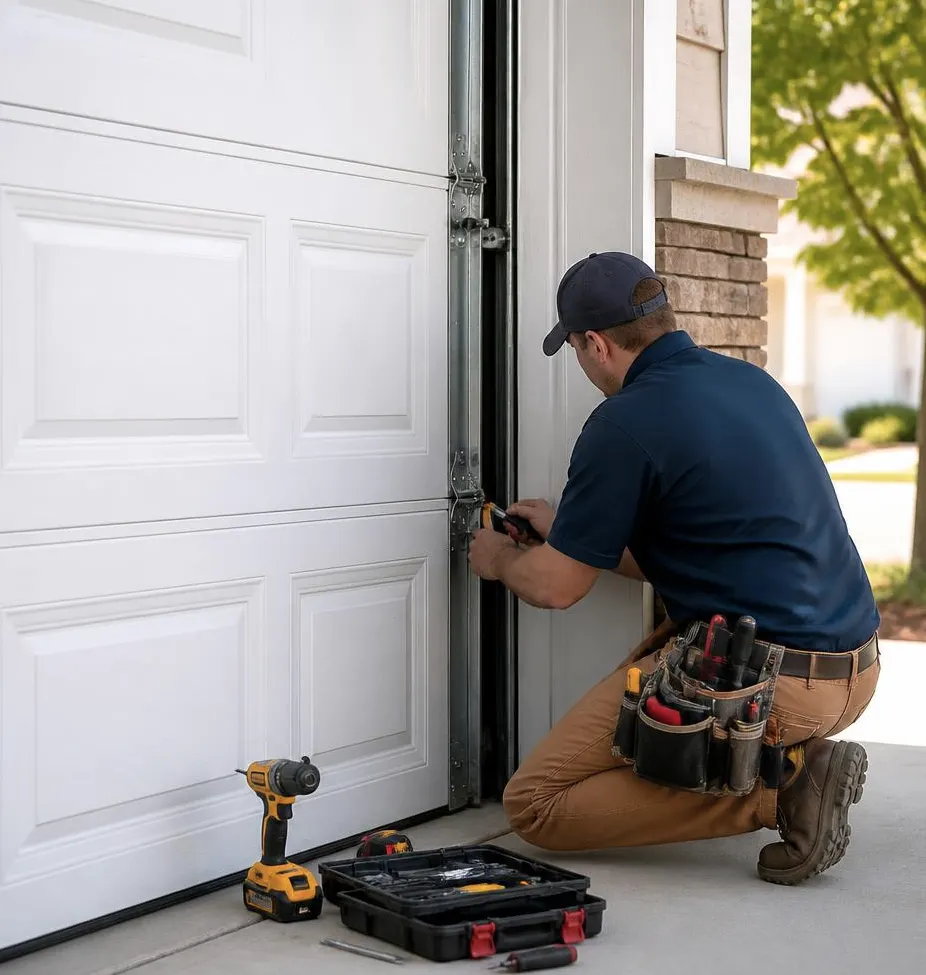
Here's what ignoring a commercial overhead door for one more season actually costs: a roll-up that jams mid-cycle during business hours, a loading dock that sits unusable while you wait for a tech who carries the right springs, and inventory or vehicles trapped behind a door that a residential-grade fix won't solve. That's a different kind of expensive than a squeaky home garage door, and it's exactly why this argument keeps coming up in Westside households that run a small business, rent a storage unit with a roll-up, or just assumed "a door is a door."
So let's settle it.
The Argument: "It's the Same Door, Just Bigger"
One side of this argument usually goes: springs are springs, panels are panels, and a bigger door just means bigger parts. The other side has probably stood next to a commercial door that's stuck halfway up during a delivery and knows that's not true. Both are overhead doors, both use springs and tracks and an opener — but the engineering underneath is built for a completely different workload.
What Actually Makes a Commercial Door Different
Cycle count
A home garage door usually goes up and down a handful of times a day. A commercial or warehouse door tied to a loading area, a retail bay, or a shared garage can cycle ten to twenty times a day or more. Every part — springs, cables, rollers, hinges — wears out faster simply because it's doing more work, more often.
Spring and hardware ratings
Commercial torsion springs are rated for a much higher cycle life than the springs on a standard home door, and the shafts, bearings, and cable systems are built heavier to match. Put residential-grade hardware on a high-traffic commercial door and you'll be replacing springs far more often than anyone budgeted for.
Operators and safety features
Home garage door openers are typically chain, belt, or screw-drive units designed for light daily use. Commercial operators are often chain-hoist or jackshaft systems built for continuous duty, sometimes with separate safety edges, photo eyes positioned for foot traffic, and controls designed for employees who aren't the homeowner and may not treat the door gently.
Material and weather exposure
Commercial doors are frequently heavier-gauge steel, sometimes insulated differently depending on what's behind them, and often exposed to more open-air conditions — loading areas, carports, semi-outdoor storage — than a home garage tucked under a roofline. Near the coast, that means more direct exposure to salt air, which accelerates rust on hinges, tracks, and bottom panels faster than it does on a fully enclosed residential garage.
What Maintenance Looks Like for Each
Here's the part that actually resolves the disagreement: both doors need regular attention, but on different schedules and with different priorities.
Residential garage doors generally need:
- Lubrication of rollers, hinges, and springs every few months
- A visual check of cables and spring tension once or twice a year
- Weatherstripping replacement when it cracks or lets in dust and drafts
- An opener safety check — reversal sensors and auto-reverse — a couple times a year
Commercial and warehouse overhead doors generally need:
- More frequent lubrication and hardware inspection, often quarterly, given the higher cycle count
- Earlier spring and cable replacement, since high-cycle springs wear out well before they look obviously worn
- Operator and safety-edge testing, since these doors are more likely to be used around employees, customers, or vehicles
- Closer rust monitoring on tracks and bottom panels, especially in units exposed to open air, winter rain, or salt-heavy coastal air
- Attention to dust and debris buildup in tracks during dry, windy stretches when wildfire smoke and dust are more common
When the Two Doors Actually Need the Same Attention
There's one place the argument collapses in the middle: earthquake retrofit hardware. Whether it's a home garage door or a commercial roll-up, older bracket systems that haven't been updated can fail the same way under seismic stress, and both deserve a look if the door or its hardware predates more recent retrofit standards. Age and exposure don't care whether the building is residential or commercial.
When to Call Santa Monica Garage Door
If you're running a business, managing a shared commercial property, or maintaining a storage facility with a roll-up door that's cycling heavily every day, it's worth getting on a scheduled Garage Door Maintenance plan built around commercial cycle rates rather than a once-a-year home checklist. And if that door is already sticking, slow to close, or making a grinding sound under load, that's a sign to call for Commercial Garage Door Service before it fails during business hours rather than after. We'll inspect the springs, cables, track alignment, and operator separately from any residential work on the property, because they genuinely are different jobs.
Whether it's the door on your house or the one on your shop, loading bay, or storage unit anywhere from Santa Monica to Culver City, Marina del Rey, or Pacific Palisades, Santa Monica Garage Door can tell you which schedule your door actually needs. Call us to get both doors — home and business — on the right maintenance plan before the next busy season finds the weak spot for you.