
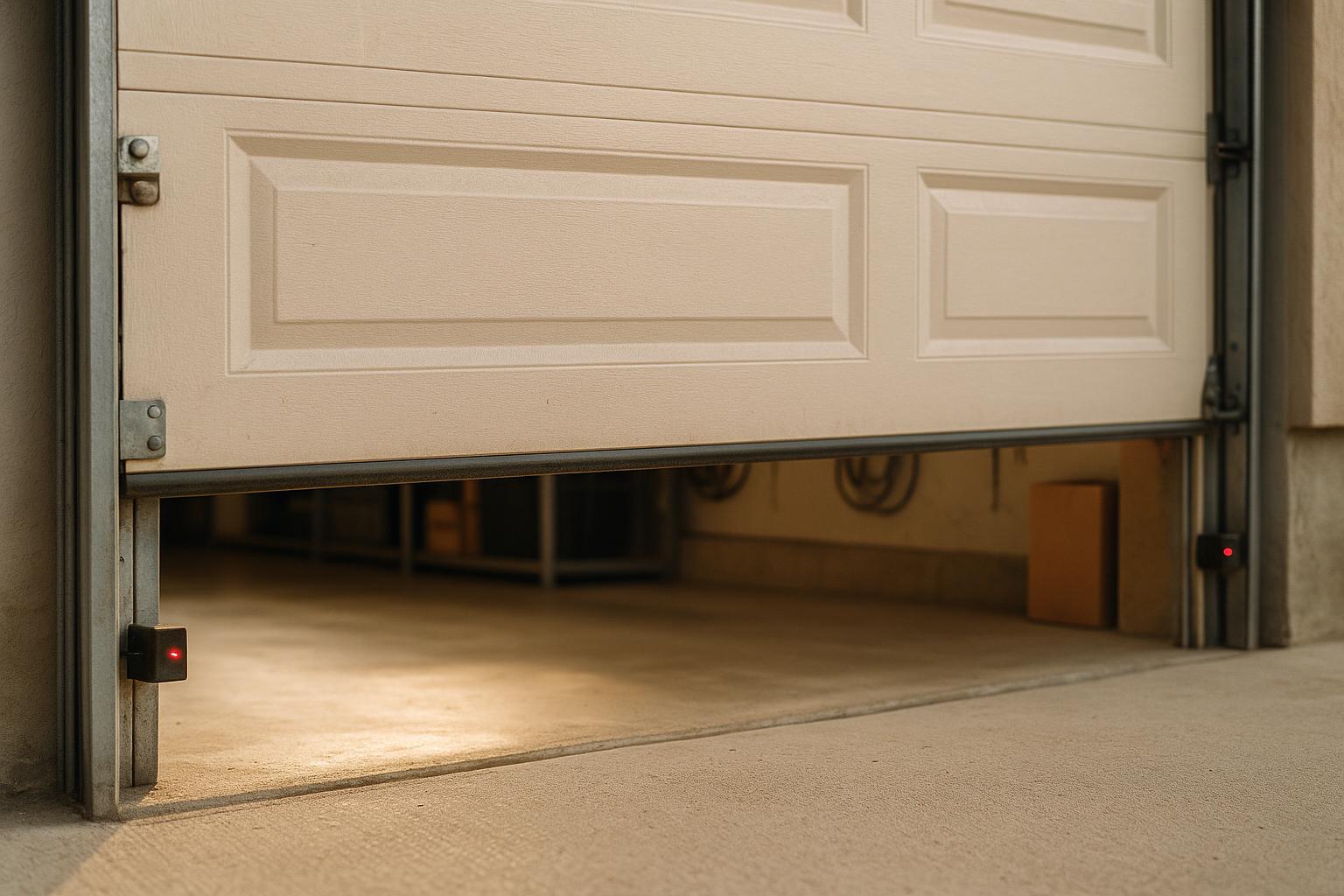
That Frustrating Reverse: What's Really Going On
You press the button on your garage door remote, the door starts its descent, and then — just inches from the ground — it stops and reverses back up. You try again. Same thing. Maybe it worked fine yesterday, but today it refuses to close completely.
This is one of the most common garage door complaints we hear from homeowners in Santa Monica, and the good news is that it's almost always fixable. The bad news? There are several possible causes, and diagnosing the wrong one can lead to wasted time, money, or even a safety hazard.
Let's walk through the most likely reasons your garage door reverses before reaching the floor and what you can do about each one.
1. Misaligned Safety Sensors
This is the number one cause of a garage door that reverses before closing. Every garage door opener manufactured after 1993 is required to have photo-eye safety sensors — two small devices mounted near the bottom of the door tracks on either side. They send an invisible infrared beam across the opening, and if anything breaks that beam, the door reverses to prevent crushing a person, pet, or object.
Here's the thing: these sensors are sensitive. Over time, they can shift out of alignment from a bump, vibration, or even settling of the garage structure. When the two sensors can't "see" each other, the opener interprets it as an obstruction and reverses the door.
What to check:
- Alignment: Look at the LED indicator lights on each sensor. Typically, one glows green (sending) and one glows amber or green (receiving). If either light is blinking or off, the sensors are likely misaligned.
- Obstructions: Remove any boxes, tools, cobwebs, or debris blocking the sensor's line of sight.
- Dirty lenses: Wipe the sensor lenses with a soft cloth. Dust, salt air, and grime — all common along the Santa Monica coast — can cloud the lenses enough to disrupt the beam.
- Loose brackets: The small metal brackets holding the sensors can loosen over time. Gently adjust them until both indicator lights are solid.
2. Incorrect Close-Limit Settings
Your garage door opener has limit settings that tell it exactly how far the door should travel when opening and closing. If the close-limit setting is off — even slightly — the opener may think the door has hit an obstruction when it's actually just reaching the floor. The opener's built-in safety feature then kicks in and reverses the door.
This issue often appears after a new opener installation, a spring replacement, or when temperature changes cause the metal tracks and door panels to expand or contract. In a coastal city like Santa Monica where temperatures can swing between morning fog and afternoon heat, seasonal limit adjustments aren't unusual.
What to do:
Most openers have limit adjustment screws or a digital setting accessible through the wall-mounted control panel. Your owner's manual will show you where to find them. The close-limit needs to be increased slightly so the opener allows the door to travel those last few inches. If you're not comfortable making this adjustment yourself, a professional can dial it in within minutes.
3. Worn or Damaged Rollers and Tracks
When rollers wear out, crack, or accumulate debris, they create resistance as the door moves along the tracks. If the resistance is significant enough, the opener's force sensor detects it as an obstruction and reverses the door.
Similarly, bent or misaligned tracks can cause the door to bind or stick at certain points during its travel. You might notice the door hesitating, jerking, or making grinding noises before it reverses.
Signs to look for:
- Visible cracks or chips in nylon rollers
- Metal rollers that no longer spin freely
- Dents, bends, or gaps in the vertical or horizontal tracks
- Grinding or scraping sounds during operation
Replacing worn rollers is a relatively affordable repair that can dramatically improve how smoothly and quietly your door operates. Track realignment is also straightforward for a trained technician.
4. Broken or Weakening Springs
Your garage door springs do the heavy lifting — literally. They counterbalance the weight of the door so the opener only has to provide a small amount of force to move it. When a spring weakens or breaks, the door becomes significantly heavier than the opener expects.
A weakened spring might allow the door to open normally (since gravity helps on the way up with torsion spring systems) but struggle on the way down, causing the opener to sense excessive force and reverse. In some cases, the door may close partway and then reverse, or it may reverse immediately.
Important safety note: Garage door springs are under extreme tension and can cause serious injury if handled improperly. Spring replacement is not a DIY job. If you suspect a spring issue, call a professional.
5. Force Settings Need Adjustment
In addition to limit settings, your garage door opener has force settings that control how much power it uses to open and close the door. If the downward force is set too low, the opener may not push hard enough to fully close the door, interpret the normal resistance of the weatherseal hitting the floor as an obstruction, and reverse.
This can happen gradually as springs age and the door requires slightly more force, or suddenly after a repair or part replacement changes the door's balance.
The force adjustment is usually located near the limit adjustment — either as a screw or a digital setting. Increase it in small increments and test after each adjustment. Be careful not to set it too high, as excessive force defeats the purpose of the safety reverse feature.
6. Damaged Weatherseal or Uneven Floor
Sometimes the problem isn't the door or the opener at all — it's what the door is closing against. A thick, stiff, or bunched-up bottom weatherseal can create enough resistance to trigger a reversal. Similarly, if your garage floor is uneven or has settled over time, the door may contact the high spot before fully closing, causing the opener to reverse.
Inspect the rubber weatherseal along the bottom of your door. If it's cracked, hardened, or deformed, replacing it is inexpensive and can solve the problem immediately. For uneven floors, a technician can adjust the door or install a flexible seal that conforms to the surface.
When to Call a Professional
Some of these fixes — cleaning sensors, removing obstructions, wiping lenses — are simple enough for any homeowner. But if you've checked the obvious causes and your door still reverses, or if the issue involves springs, tracks, or opener mechanics, it's time to call in a professional.
At Santa Monica Garage Door, we troubleshoot reversing doors regularly for homeowners across Santa Monica, Brentwood, Pacific Palisades, Venice, and the surrounding Westside communities. We carry the parts and tools to diagnose and fix the issue in a single visit, so you're not left with a door that won't close overnight.
Don't Ignore a Reversing Door
A garage door that won't fully close is more than an inconvenience — it's a security risk. An open garage is an invitation for theft, pests, and weather damage. It also means your opener is cycling repeatedly without completing its job, which accelerates wear on the motor and other components.
If your garage door has started reversing before reaching the floor, address it sooner rather than later. Whether it's a quick sensor adjustment or a more involved repair, getting it fixed promptly protects your home, your belongings, and the lifespan of your garage door system.